News & Stories
Searching for relevance in a sea of 39 million scientific papers
A bioinformatics team at Morgridge created a new hybrid machine learning tool that reduces two stubborn problems when mining insights from big data: false positives and hallucinations.

When the box pushes back: Reflections on the spirit of resilience at Morgridge and WARF
Roma Broadberry has a unique perspective on Wisconsin science, as both a biophysics Ph.D. student in the Tim Grant Lab at Morgridge, and a WARF ambassador. Broadberry reflects on the resilience that helps both organizations thrive in challenging times.

Rising Sparks: Beth Moore, computational biology
Spurred by the small triumphs of writing successful code and the endless learning to be had through collaborations, computational biologist Beth Moore builds tools for tackling mountains of scientific literature and biological data.

CHAMMI-75: Finding common ground across millions of biology images
Using nearly 3 million images from 75 studies, Morgridge scientists have developed a new machine learning tool to examine cellular morphology.
Featured Event
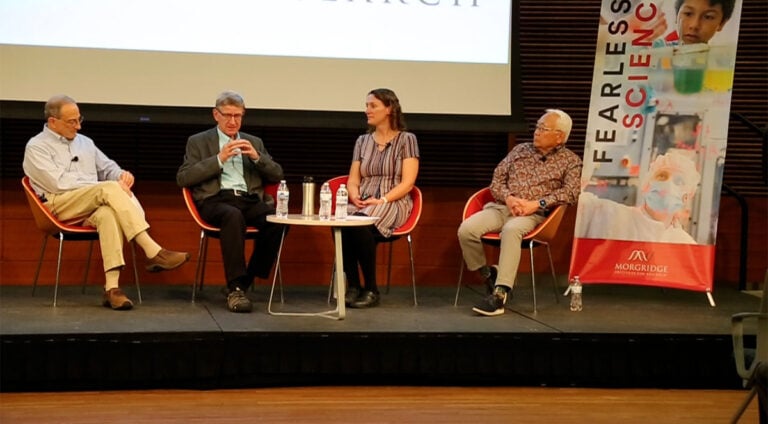
March 10 @ 5:00 pmFearless Science Forum: The Art of Seeing More
Science and art are often thought of as mutually exclusive passions, but creativity and curiosity entwine these disciplines. The Morgridge Institute for Research will partner with the University of Wisconsin–Madison to host our latest Fearless Science Forum, The Art of Seeing More, an exploration of the creative connections between science and art. Panelists include Morgridge Investigator Randy Bartels, Letters and Science Dean Eric Wilcots, and Professor and artist Meg Mitchell.